Welcome To Technext Technosoft
Mon-Sat: 10 AM to 7 PM - Sun: Closed

Welcome To Technext Technosoft



02/10/2026
Durgapur was never supposed to be a quick commerce battleground. That was reserved for cities like Delhi, Mumbai or Bengaluru. But somewhere between 2024 and 2026, the city quietly turned into one of the most closely watched Tier-2 markets in India's instant delivery story. Blinkit walked in first. Flipkart Minutes followed close behind. And what started as a convenience service for late-night snack cravings has become a genuine tug-of-war for the city's shopping habits.
This case study breaks down how both brands used digital marketing and local SEO to win over Durgapur, not through guesswork, but through a playbook that's worth understanding if you are building any kind of hyperlocal brand today.
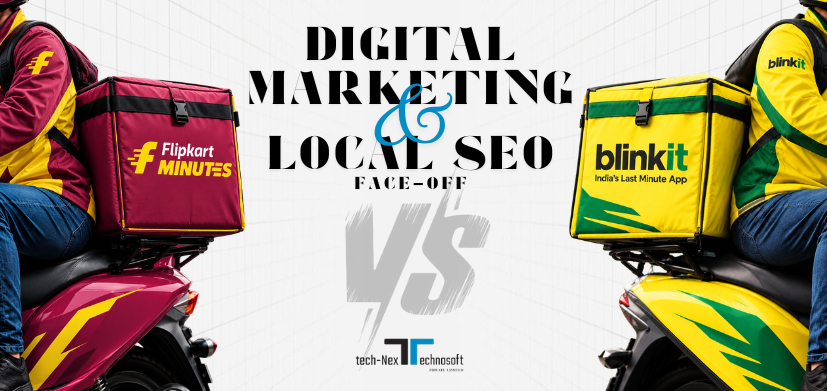
A few years ago, if you needed groceries in Durgapur, you basically had two options - walk down to the kirana store, or order online and just wait till the next day. That was it. Then Blinkit arrived, and that whole routine got rewritten almost overnight. It started tucking small dark stores into residential pockets across the city - quiet little micro-warehouses that most people never even noticed. Suddenly deliveries were landing at doorsteps in 10 to 15 minutes. No standing in line, no picking a delivery slot and hoping it holds, no trade-off between speed and convenience anymore.
The app caught on fast. Once a critical mass of Durgapur residents got used to ordering milk, medicines, or a forgotten birthday candle and having it show up before the doorbell even finished ringing, there was no going back to the old way of shopping.
Flipkart was not about to sit back and watch Blinkit run away with the market. It hit back with Flipkart Minutes. This is the part that surprised a lot of people. It didn't push Tier-2 cities to the bottom of the priority list. Quite the opposite, actually. Company data puts Durgapur among Minutes' fastest-growing markets, with customer adoption here, along with Siliguri and Bhagalpur, climbing nearly 25 times year-on-year. That kind of number doesn't happen by chance. It happens when a company decides a city like Durgapur is worth fighting for, not just settling for.
Blinkit didn't win Durgapur by accident. Its approach has always leaned on a few core ideas, executed with real discipline.
Flipkart didn't try to out-Blinkit. It leaned on what it already had - scale, logistics muscle, and a customer base that already trusted the Flipkart name.
Digital marketing gets people curious. Local SEO is what gets them to actually open the app when they are standing in the kitchen at 9 pm with nothing to cook. Both brands treat this with real seriousness.
Blinkit and Flipkart Minutes both optimize for hyperlocal search behaviour like "grocery delivery near me," "medicine delivery in Durgapur," or increasingly, voice-search queries like "order milk near City Centre Durgapur." Real-time inventory syncing with Google Maps, structured local business data, and dark-store-level geo-targeting all play into who shows up first when someone searches with genuine urgency.
The interesting twist in 2026 is that local SEO for quick commerce isn't just about keywords anymore. It's about entities. Google increasingly wants proof that a listed dark store is a real, active, serving location, not just a pin on a map. Brands that keep their store data fresh and locally relevant win the moment that matters most.
Blinkit has set up a few dark stores around Durgapur by now, and for a lot of households that's simply where the milk and the midnight snacks come from. Flipkart Minutes is closing in fast. When Flipkart listed the cities driving its growth, Durgapur was named right alongside Siliguri and Bhagalpur. Customer numbers across those smaller markets have jumped almost 25 times in a year.
Neither brand is treating Durgapur as a small-town afterthought. Both are fighting for the same customer - someone who wants their order in minutes, not hours. This fight is being won or lost almost entirely through digital visibility, not billboards.
Blinkit numbers have gotten hard to ignore. In April or June 2026 quarter, it brought in roughly around Rs.15,664 crore in revenue. This was about 78% of everything its parent company Eternal earned that quarter. It also turned adjusted EBITDA (Earnings before Interest, Taxes, Depreciation and Amortization) positive, at around Rs. 102 crore, after years of burning cash to get here.
A part of that jump comes from an accounting shift, since Blinkit now books the full value of what it sells under an inventory-led model, so the growth looks steeper on paper than it feels on the ground. Flipkart Minutes keeps its books closer to the chest. There’s no revenue figure to point at, but the company says the business has grown fourfold in a year, with nearly 1,200 fulfilment centres and around 60% of customers coming back to order again. That repeat rate matters more than any single number. One is a company already counting profit. The other is still buying its way into people’s habits.
For such substantial digital marketing growth of your company, you need a partner that stands by you till your desired goals are achieved. Contact Technext Technosoft for the perfect digital marketing solutions.
